Tuesday, October 15, 2013

Friday, October 11, 2013


Moritzburg, Germany

A minor hiccup checking out of our apartment in Wroclaw while the cleaning lady called the boss to figure our how we should pay the parking fee. With that taken care of, we started heading west. Nice lunch in a small town along the way, and Aimée scored more lace curtain material at a fabric shop we found in the town. And we took in a mineral show at the town hall. And bought fruit.

Then we set the GPS for the town of Osniecznica, Poland, where family records said that Steve's great-grandmother was buried. He had pictures of the grave marker and other local information that his mother had left to him. We found the town without difficulty, and just being there was certainly a profound experience for Steve. After a few attempts to locate the cemetery near two different churches, Sue Anne spotted a florist shop that appeared to specialize in funeral arrangements, so a quick inquiry there brought about a good set of directions. Although it took a few sentences to find a common language....German. Good thing that Sue Anne knows that Friedhof means cemetery.

It was almost closing time, but the cemetery attendant did his best to help us. Though after quite a bit of searching we concluded that things just weren't of the right generation. Although there were a very few markers and architectural features from a while back, most everything was much too contemporary. Was the older area destroyed in WW II? Or were we in the wrong place? We just don't know. But simply being in this ancestral home area was certainly special.

We then worked our way back to the main road and took off in the direction of the border at Görlitz, Germany. We followed the commands of The Queen on our GPS and turned right for the final approach to Görlitz, only to find ourselves heading back into the heart of Poland on a highway that didn't exist when our map was created. This turned out not to be an uncommon situation in areas where there had been a lot of recent development. Time for an updated map.

It must have been about 15 minutes before we got to an appropriate spot for a u-turn. Then it was back to Germany, again with no customs formalities.

Then the rain hit, really hard. Traffic on the fabled Autobahn actually slowed to under 60 mph! It stayed like this for quite a while before finally abating. It was almost dark by the time we arrived in Mortizburg, a small town in the country between Dresden and Meissen. We were stunned at the first sight that appeared when we entered the town—King Augustus the Strong's modest (a large chateau like building) hunting lodge on its own island in the middle of the lake. Too late to check it out instantly, but a must-see before we left town.

Our hotel was right nearby, located in the woods in what certainly was once part of the royal hunting grounds. The parking lot was jammed, and it was clearly a very popular place. Very nicely constructed, interconnected buildings with private dining rooms and parties in progress. The bedrooms were charming with dormer windows and chintz curtains. The yellow and russet colored autumn leaves out of the window were nearly as good as back home in New England! We all enjoyed our meals near an old type ceramic tiled stove. (Sue Anne drew the stove after the meal.) Another adventure!
 
Steve at the cemetery in Osniecznica


Monday, October 14, 2013

Thursday, October 10, 2013

Wroclaw, Poland


We split up for the first part of the morning. Aimée and Steve checked out places they remembered from their previous visit here, and Sue Anne and Bruce stayed back at the apartment, doing laundry et al. We met up downtown for the English language tour we had learned about last night at the tourist office.


Our guide, Simon, had a good command of English and a very thorough understanding of the rather dynamic history of Poland and of Wroclaw's role in that history. It's complicated. The composition and location of what's called Poland has changed quite frequently over the centuries. As recently as WW II, Wroclaw was for a time a part of Germany known as Breslau. After the war the borders of Poland were shifted quite a distance to the west, taking land away from Germany and giving land in the east to Ukraine.


Wroclaw once rivaled Berlin in the scale of its economy. Its university produced a number of Nobel laureates. (And Simon as well, with a degree in philosophy) Compared to Poznan it seemed to be more robust in its state of recovery from wartime damage.


Most of the pictures below come from our tour with Simon, so the captions there will add to the description of the kind of good information we acquired from the tour.


The tour wrapped up at about 3 in the afternoon, calling for a pretty late lunch. Aimée and Steve directed us to a traditional Polish restaurant that they had discovered on their previous trip, and we feasted on an assortment of perogies and such. All very delicious.


We split up again, Sue Anne and Bruce heading back to the apartment via the row of galleries and artists' studios in the former slaughterhouse row. Light meal in our room. Back to Germany tomorrow.

The pictures:


Rear view of Sleepwalker Apartments


Archaeological site behind the apartments


City Hall Square


CIty Hall

Scene of last night's great dinner


24-hour flower stalls, just off of City Hall Square


Our 10 zloty ($3.50) arrangement


Immense market hall.  A quick pit stop on the walking tour.

Mushrooms, mushrooms, mushrooms.  They were everywhere: throughout the market, all over town, and for sale by the roadsides in the country.  Some of the roadside sales were unattended, on the honor system.


Cathedral


Monument to the Polish Cardinal who was instrumental in initiating the reconciliation between Poland and Germany after WW II.


Bridge festooned with padlocks.

By tradition, a newly married couple puts a lock here and throws the key into the river, symbolizing an eternal bond.


Locks


Dwarf graffiti began appearing around town as wry commentary on the failings of the Communist regime.  The concept caught on, and it's remembered today by many small sculptures.


This dwarf is raiding the ice cream and pastry shop,


... and lowering the loot down to his accomplice on the sidewalk.


A row of art galleries and artists' studios, constructed along the site of the former slaughterhouse.


Memorial sculpture to the victims of the slaughterhouse


We had a great tour, but now it's lunchtime.


Perogies and other traditional Polish fare for all!

Sunday, October 13, 2013

Wednesday, October 9, 2013


Wroclaw

Breakfast at our Poznan apartment, load the car, and we were off in the direction of Wroclaw. Attractive countryside, generally consisting of large fields, neatly kept woods, and the occasional small town. Autumn colors weren't quite up to New England standards (not enough reds), but lovely nonetheless.

We stopped in one of the larger towns as it looked like a good place for a morning coffee break. There was the traditional Town Hall (painted pink and white) in the middle of a square, there were shops on all four sides of the square, and there was a shop-lined street branching off of it. But there wasn't a single place for coffee. And we had learned the word for it by then...kawa, pronounced kava. No restaurant, no coffee shop, nothing! We asked a women if she could help. She thought for a long time and then suggested some place near a sport stadium. It seemed too far to go, and the directions were too complicated. We did finally find a small market and procured enough for a modest DIY juice and donut snack. Sue Anne did a drawing, and Aimée bought lace curtains while in the “town with no coffee” as we now refer to it. She had been searching for lace for a long time.

GPS took us right to the location of our rental apartment (Sleepwalker Apartments) in Wroclaw, though parking turned out to be a bit of a challenge. We did find a public parking lot, and it was a horrible mess of cars crammed in every which way. We survived the glare of a stern-faced man and did manage a relatively proper park, good enough to accommodate the car while we did the final reconnaissance of the neighborhood. That did lead us to the official parking lot for our apartment. It too was none too artistically laid out either, but it was where we needed to be.

And, quite fascinating, it overlooked a construction site that was the subject of a mandatory architectural dig prior to starting the foundations of the new buildings. We don't know what used to be there, but there were exposed remnants of brick cellars a couple of levels below grade. The university professor and archaeologist in charge told Steve that his students were excavating the latrines, customary places for throwing away broken crockery and other stuff that acquires historical value many years later. We rely upon Steve for these sort of details from his constant befriending of the locals.

While we were waiting to get in to the apartment, we savored our coffees and fruit tarts at the Café Fusy across the street.

Check in, get the final details on parking, unload the car, and react with amazement at the great layout of our apartment. Everything brand new. Full kitchen with dishwasher. Balconies front and back. Laundry room nearby. (European washing machines are SO difficult for us North Americans. All the laundry choices are in symbols we don't understand. Picture all four of us squatting down and squinting and doing our best group effort to get something washed.) The apartment was so different from the previous two days in Poznan. It was plush, and large enough to get lost in.

It was an easy walk to the City Hall square. Aimée and Steve recognized a few places from their previous visit here, and we decided on dinner at the restaurant in the basement of City Hall. (It would be the Ratskeller in Germany, but we weren't sure what the Polish word might be.) We did think to check ahead of time whether they accepted credit cards, and the negative answer brought about a quick trip to the ATM as we were all pretty low on zlotys. Then we settled down at our table. The restaurant was utterly beautiful inside. Clearly a source of pride for the city. Dinner was delightful. We did discover that a 'large' wine consisted of a large, full glass accompanied by a large carafe containing at least two more glasses, and a 'small' was essentially the same thing only smaller. As it was throughout Poland, prices were very reasonable, and the food delicious and beautifully presented.

Then a bit more wandering in the square led us to the 24-hour outdoor flower market. Who would have thought that there would be enough demand to make something like this feasible. Are there that many guys who go out drinking with their buddies and need a late night / early morning bribe to get back into the house? For a mere 10 zlotys (a bit over $3) we procured a very nice little arrangement to bring back to our apartment. Sue Anne's estimate would put the equivalent at about $15 back home in the US. (The flowers are still alive and well and have been traveling with us for days now.)

No pix today. It was a travel day. Lots of them tomorrow from our day in Wroclaw. Oh, yes, it's pronounced something like 'Frot-swaf'. But we don't roll the r's well.

Saturday, October 12, 2013

Tuesday, October 8, 2013


Poznan

Despite its unconventional location, all went well in our first night in the apartment near the junkyard and the trolley tracks. We took advice from Iza, our apartment owner, and ate at a nearby restaurant. Delish. Or das schmeckt sehr gut.

Today we made breakfast from food that Iza had provided (eggs, onions, and zucchini), and then we headed into town. We were ill advised and headed in the wrong direction. The problem was solved by Sue Anne and a nice lady conversing in French. Since we didn't really know too much about the place, we concentrated on wandering around, exploring, and hitting the tourist info office.

As was the case pretty much all through Poland, there had been a lot of destruction in WW II, but most cities had chosen to rebuild exactly as the buildings were before the war. The old market square (stary rynek in Polish) was stunningly beautiful. The building facades are amazingly ornate, and the surfaces were cheery colors....pink, yellow, green, blue, and orange too.

Crowds gathered at noon for the local attraction...two goats pop out of the City Hall tower, and butt heads twelve times. Toddlers giggled. It was good people watching...school children, babies, and fashion forward young people. Twenty percent of the population is university students. The young ladies are good at walking on cobblestones while wearing heels.  And naughty little boys chasing pigeons. And one clever sparrow who snuck in and stole the loot from right under the pigeons, twice! Then we found a pedestrian street, a very upscale indoor mall (great lunch), and a bead store for Aimée.

Advice we received from a tourist guidebook: If you need directions in English, ask a young person. If you need them in Russian, ask an older person. The instructions turned out to be quite correct as far as our experience with the young people would indicate. We did have one situation with a middle-aged person, however, where French was the language of choice, as mentioned above.

Poznan was the site of the first Polish insurrection against the Russians, in 1956. It set the scene for subsequent protests, ultimately resulting in a form of government that was less tightly controlled by Russia. But well short of home rule. That didn't happen till the collapse of the Iron Curtain.  There is a monument in town to the 1956 events, and also one to those murdered in the aftermath of the escape from Stalag Luft III (The Great Escape) which was not too far away.

Beyond this brief description of the day, we'll let the pictures speak for themselves.

The aforementioned junkyard

Lots of wonderful old architecture, some better taken care of than others.

City Hall

Goats are a symbol of Poznan.  Here they are butting heads 12 times at noon in the glockenspiel at the City Hall.
School children in the square counted the hours out loud.


Goats


More goats
Buildings on the square.  All were reconstructed in original form  after WW II.


Some Polish words were easy to understand.


But some words not so much so.  Antyki is easy, but the rest of them?

Colorful group of daycare kids

Great lunch!
It was the daily special at a very upscale shopping mall—turkey ragout with Indian spices and a glass of wine, all for just over $8.

Thursday, October 10, 2013

Monday, October 7, 2013


Berlin

Breakfast at the hotel, pay up, say goodbye to Frau Baalmann, pack the car, return the precious Zone 9 parking permit, and we were on our way. First item on the agenda was to get to the Tin Figure store, now that it was Monday and it should be open at 10. It was easy to get there, but impossible to park. We finally gave up.

Parking in Berlin is a tremendous challenge. There are different rules for every little stretch of the road--need a residential permit for the right zone, need to buy a ticket from the machine, sometimes both are acceptable, applicable only during certain hours, temporarily overruled due to construction (there's lots of that going on), and the like. Until you establish a regular pattern, it's a matter of finding a place that seems to be legal, maneuvering into the space, and then getting out and examining the fine print on the various signs, some of which could be quite a ways down the block. And even if you've established a regular pattern, you still have to be on the lookout for the temporary exceptions.

So, having failed to get to the Tin Figure store, we turned on GPS and asked The Queen to send us to Poznan, Poland. Easier said than done. She wasn't aware, of course, of any of the construction detours that we would encounter. Umleitung is the word for detour—remember that word, as it's an important one. And if you're in an area with lots of construction there might be many of them going on simultaneously, so be sure you know your Umleitung's number, as it will appear on the signs.). GPS also tended to lose sync and had to recompute when we got into urban canyons where the satellite signals couldn't penetrate. We followed faithfully, interpolating through the dead zones, and finally breathed a sigh of relief when we were clearly out of town and on a long, straight road. We could never recreate the exact route that we ended up taking.

Entry into Poland was utter simplicity. No customs formalities whatever, despite its not yet having become a member of the EU. Long, straight roads, very wooded with well maintained trees, and large open fields, some occupied by industrial quantities of flowers. Fields of yellow, and purple. And bright green, and corn stubble too. Very flat terrain.

We found ourselves driving down quite a grand avenue as we neared our destination in Poznan, another Airbnb rental. The final turn however brought us to the service road behind the nice homes, with a view of very busy trolley tracks, and a junkyard. Another adventure! After a minor mixup in scheduling, our hostess Izabella (Iza) arrived and let us in to her apartment in a building at the end of the street, overlooking the junkyard. Junkyard aside, it was basic but pleasant. It truly was her own home, and she would stay with a friend whenever she was able to rent it out. We had full run of the place, including all the food in the kitchen! And her father's plum wine. Produce from his garden was stashed everywhere: onions, pumpkins, walnuts and a basket of large zucchini. We chopped up one said squash into omelette and soup.

Dinner was at a very nice restaurant, located within a recently reconstructed set of buildings that trace back to when a large number of Germans from Bamberg, many of Polish background, were offered incentives to move back to Poland to swell the workforce and improve the economy. All this happened after the Black Death, so we are talking many centuries ago. The meal was delightful. Steve had a traditional Polish soup called sour rye with honey and mushrooms.

It is mushroom season here. They are all over the menus, and the markets. People are collecting them in the woods and selling them on the street corners.

No pix from today's adventure. Lots coming up tomorrow.

Tuesday, October 8, 2013

Sunday, October 6, 2013

Sunday, October 6, 2013


Yesterday we stuck to the heart of the former West Berlin, the ever vibrant Ku-damm. Today we headed over to the heart of the former East Berlin, which could easily also be called Old Berlin. This is the home of the Bundestag (the national legislature—the building was originally called the Reichstag), the palaces, the museums, the cathedral, the opera, and the other monumental treasures of a longtime and once again capital city of world standing.

On our 2000 trip, the East was just coming out of a lull after the Fall of the Wall. Things needing fixing had been fixed, but major 'progress' was still a ways away. That was a nice combination, as things were still relatively stable and quiet. This time, progress was moving ahead at full force. Unter den Linden, the grand avenue, was totally torn up for subway construction, due for completion in 2019. Lots of space around the Brandenburg Gate was fenced off for other projects. And westernization had set in, in the form of Starbucks, Dunkin' Donuts, and the like.

The Bundestag was open for tours, but there was a long line at the reservation booth and the earliest available reservations were for 2PM. So we opted for the exterior view.

Our meal times shift around from day to day. Steve and Aimée were opting for the fruit and muesli for breakfast in addition to several kinds of bread, rolls, butter, jam, boiled egg, ham and cheese. Bruce and Sue Anne passed on the muesli/yogurt/milk so were a bit hungrier sooner. Resulting in a quick lunch at the outdoor / stand up curry wurst stand. Where we chose a curry boulette...sort of a meal ball, really several small ones, with warm ketchup and curry powder sauce. It is Turkish street food.

Aimée did however stop by the Starbucks at Pariserplatz for coffee, and when there she picked up a brochure advertising guided tours. One of them, a two hour tour of the immediate area where we were, was 'free' (tips accepted), left from Starbucks at 2PM, and was conducted in English. This sounded good all around, so we did a bit more wandering in the area to use up the time and then showed up in front of Starbucks a few minutes before 2.

The tour was conducted by a young man from London. He had taught history there for a few years and then moved to Berlin out of love for the city. He has developed a deep understanding of so many aspects of its history and culture, and he certainly conveyed this throughout the tour. The tour ended up running for about three hours, took us through many centuries of history, and every minute of it was filled with good information. The guide certainly earned his tip, which easily amounted to what a regular tour would have cost—or more.

A walk back to our car through a flea market / art market along the river. Delightful dinner at the Turkish restaurant. Aimée and Steve were welcomed back by the waiter.


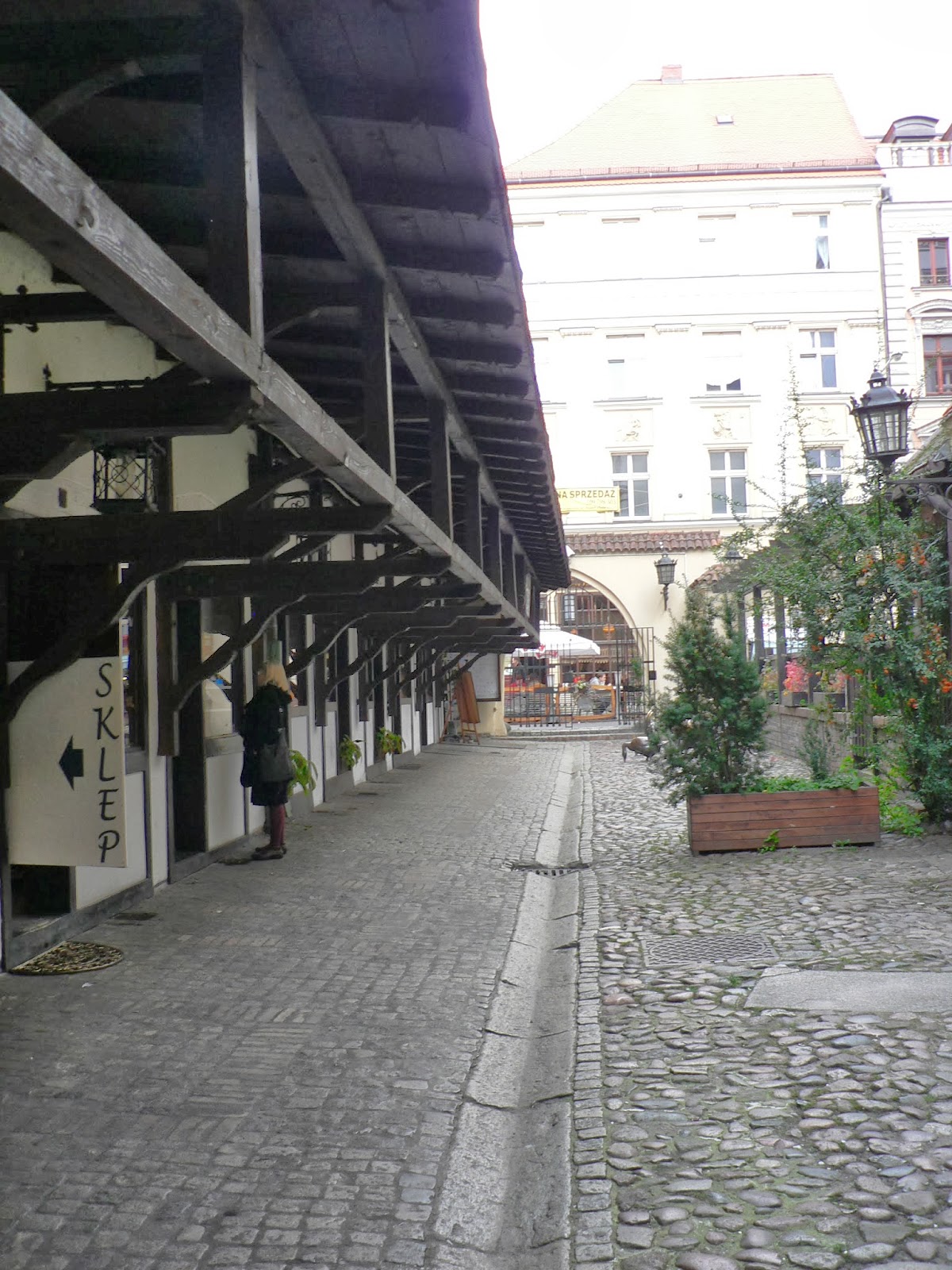
Our hotel occupies one floor in an old building with lots of marvelous architectural detail.  Here's the banister leading up from the entryway.


Wall in the entryway
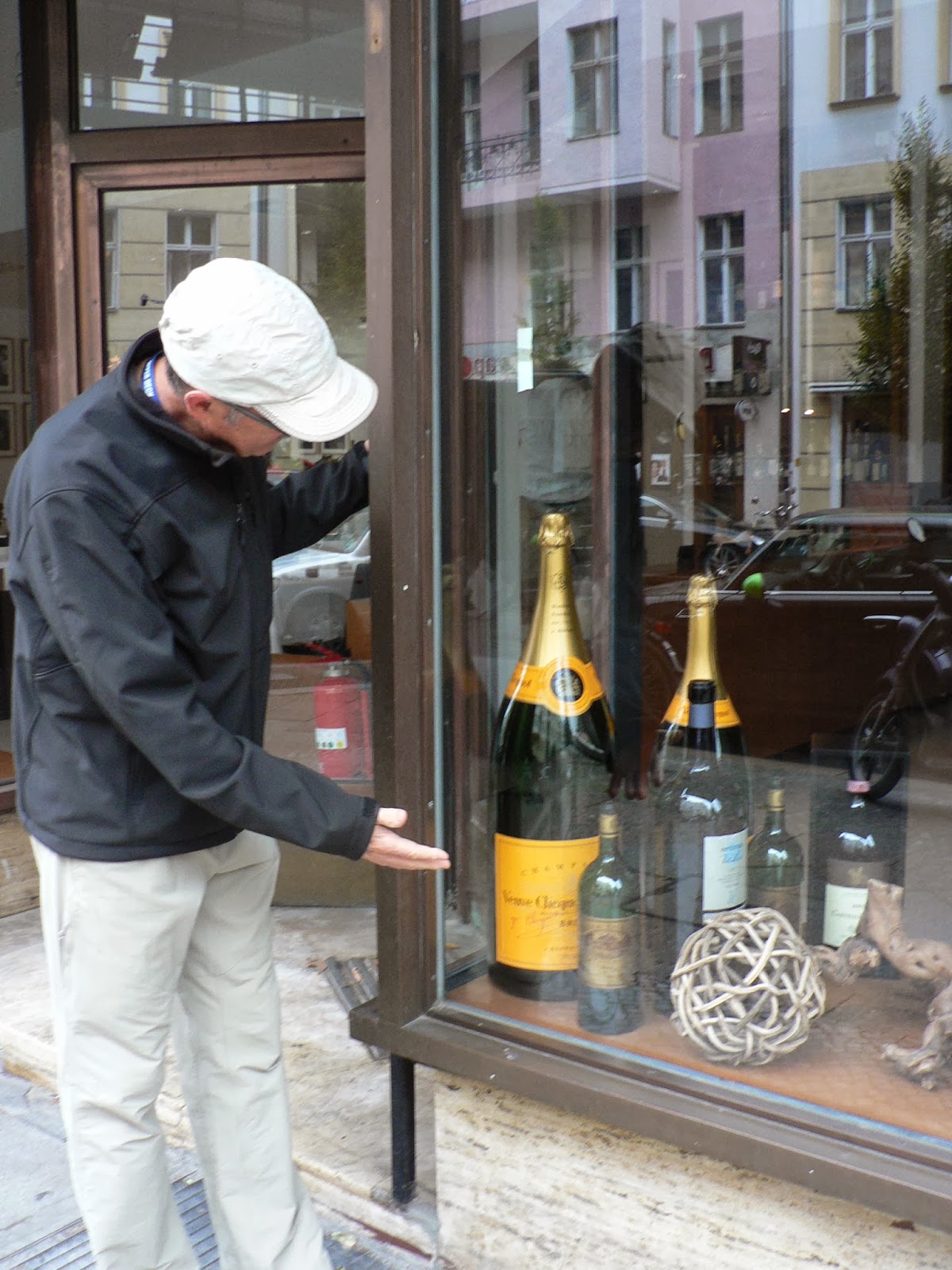
Steve lusting over champagne bottle.


Bundestag (formerly Reichstag)


Rear view of Bundestag showing recently added glass dome


Brandenburg Gate seen from Pariserplatz, looking back toward the West


Closeup of the statue atop the Brandenburg Gate.  Napoleon stole it once, but the Germans retrieved it and modified it with a few clever anti-French features.

East Berlin got to see the front of the horses; West Berlin got the rear view.
Memorial to victims of the Wall, and to victims of the uprising of June 17, 1953.

Sue Anne, Steve, and Aimée at the Wurst stand

Side view of Brandenburg Gate from the West.
Portapotties awaiting removal after German Unity Day celebration last week

Meditation group in Pariserplatz


Pedal bar awaiting its customers


Pedal bar in action


While the government of East Germany was never known for humor or whimsy, their traffic light man (Ampelmann) was very clever.  There was outcry when the more staid one from the West began to replace him, and now the tables are turned.  This guy has become a symbol, is now appearing in the West, and has spurred an entire line of merchandise.

There was also a yellow Ampelmann, moving quickly with his hat about to fly off, but we didn't see much evidence of him on this trip.

The sign reads "From the East's Traffic Light to Cult Figure".


Buy your Ampelmann lawn chairs here, choice of red or green.
Shell game on the sidewalk of Unter den Linden


Memorial to Jewish victims of World War II.  Quite a controversial design, intentionally presented with no explanation.  Visit it and reach your own conclusions.


It becomes dark and foreboding when you enter it.  
One stretch of the Wall preserved in place, though fenced off to keep souvenir hunters from destroying it


Museum of the Trabant (nicknamed Trabi), the iconic car of the East.  Many Trabis have been restored and can be rented for a spin around town.


Bruce 'driving' a Trabi in a souvenir shop


Memorial to the first book burning, set beneath the square in front of Humboldt University

One of many Museums on Museum Island